

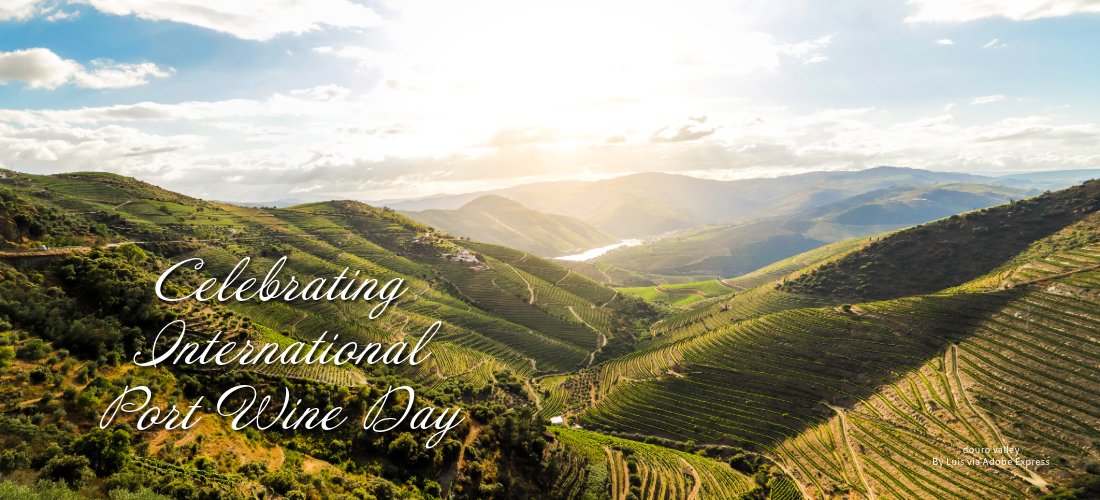
International Port Wine Day
September 10th
Port is a fortified dessert wine from the Duoro Valley in Portugal. A glass of Port and a cigar after dinner…wait, that’s outdated. Port is not a stuffy old wine. It is downright delicious!
Port is from Portugal. Portugal sits on the western side of Spain on the Iberian Peninsula. Founded in 1143, Portugal is the oldest nation-state in Europe. Portugal had a vast overseas empire for a period.
They navigated around the globe. You see this today in the language of Brazil which is Portuguese. It is also the official language of Angola, Mozambique, and Cape Verde, among other places.
In addition to the mainland section of the Iberian Penisula, the islands of the Azores and Madeira are part of Portugal.
Porto (or Oporto) is the city that sits at the mouth of the Douro River, where it meets the Atlantic Ocean. It is, in fact, a port well known for its most significant export, Port Wine.
In 1703, a treaty was signed with England regarding the trade of this fortified wine.
This wine is by far the most well-known coming out of Portugal, but the country does boast over 350 different varieties of grapes. Here in the Douro Valley, they focus on just a few.


Grape Varieties for Port
There are 5 main varieties of grapes used in Port:
- Touriga Nacional,
- Touriga Franca,
- Tinta Roriz,
- Tinta Barroca,
- and Tinto Cão.
Regions in the Douro Valley
These are grown on terraces on the hillsides along the Douro River, about 40 miles inland from Porto and continuing to the Spanish Border. The boundaries of this wine region were set in 1756, making it one of the first demarcated wine regions in the world.
The region is divided into 3 sections:
Baixo Corgo is the part of the region that is furthest west and closest to the Atlantic. The climate here is more maritime and wetter, with fertile soils. This produces a lighter style of Port.
Cima Corgo is the central part of the Douro Valley, where the climate is warmer, and the slopes are steep and rocky. Here is where you find the primary vineyards for quality port.
Douro Superiore is the largest and easternmost region. Here, it is even warmer, with less rainfall. You will find more vineyards in this region that produce unfortified wine.
If you visit the region, you will want to take a boat trip up the Douro. The views of the steep vineyards that line the river are stunning.
Making Port
The grapes are harvested and traditionally were foot trod in these low concrete or granite troughs called “lagares.” The grapes would be dropped in, and a line of men, arm in arm, would tread back and forth, crushing the grapes. Today, this is done mechanically.
The wine is fermented quickly, then fortified to between 19 and 22% abv by adding grape spirits. This stops fermentation while there is still sugar in the wine. After the winter, the wine was traditionally barreled (they call these barrels “pipes”) and were placed in flat bottom boats called “barcos rabelos” to take them to the great Port Houses of Porto. A bit of this still happens for the show, but primarily, the wine is now being trucked to Porto.
Taking the wine to Porto was for a couple of purposes. Of course, this made it closer to where it would be shipped from, but also, the humidity closer to the ocean minimized evaporations while the wine was aging.


Types of Port
There is red port, white port, and even a rosé port. Then there is Tawny Port, which is the delicious aged stuff. There is Ruby port, Reserve Port, LBV (late bottle vintage) Port, Tawny Port, Vintage Port, Single Quinta Vintage Port, Colheita Port, White Port, and Rosé Port. Then there are the 10-year, 20-year, 30-year and 40-year Ports. Whew! So many styles!
When it comes to White Port, Gouveio and Malvasia Fina are used.
Flavors and aromas in Port
Port can often have notes of blackberry, caramel, dark chocolate, and spice. (I said it was delicious, right?)
It is often an after-dinner drink, something to savor and sip. It pairs beautifully with chocolate desserts or with blue cheese. We actually doubled down on this and made chocolate brownie blue cheese cheesecake bites to pair with a Port awhile back (you’ll find a link to that article below)
So spoil yourself! It’s time for the weather to get a little cooler. Curling up in the evening with a glass of port and a good book sounds like a perfect plan!


More on Port from Crushed Grape Chronicles
https://www.crushedgrapechronicles.com/day-4-in-portugal-12-days-of-wine-2022-the-global-edition/
Remember that blue cheese chocolate bite I mentioned?
Well, the link above will take you to that recipe.
I will admit, when I created this recipe, I threw the kitchen sink at it! It is a lush chocolate brownie, creamy cheesecake, rich cherry pie filling, and blue cheese; all swirled to perfection (IMHO).
Is the idea of blue cheese in this freaking you out? Feel free to leave it out. The tanginess of the cream cheese will give it the lift it needs, maybe swirl it in to just part of the batch, and see what you think!
Then, pop on your fuzzy slippers, find a fireplace, maybe a good hardcover book and sip your port while enjoying a bite!


Robin Renken is a wine writer and Certified Specialist of Wine and WSET 3 Certified. She and her husband Michael travel to wine regions interviewing vineyard owners and winemakers and learning the stories behind the glass.
When not traveling they indulge in cooking and pairing wines with food at home in Las Vegas.

Check out our book series, “Tempting Spoonfuls” available through Amazon!
Inspired by the flavors and aromas in wines, these books create “tempting spoonfuls” of flavors to pair with wines.
“Tempting Spoonfuls – Pairing single bites with glorious wines” – Our first book paired wines from boutique wineries on the west coast, in California, Oregon, and Washington, with delicious spoonfuls.
This book is 60 pages, 18 recipes, lots of beautiful photos, and insights into some fantastic small wineries!
“Tempting Spoonfuls – small bites paired with wines from around the Globe” – This book takes us around the globe to explore 12 wine regions, a wine from the region, and then gives you a recipe for a pairing!
A slightly larger book at 104 pages, this time you learn about pairing with a type of wine from a region. Rather than a specific bottle, you can look for a style of wine from a region and feel confident that it will go well with the recipe pairing we provide. We give you 12 recipes, each to pair with a wine.
The goal is to make your mouth water and encourage you to create your own “Tempting Spoonfuls.”


2 comments
Leave your reply.