


WAugust – Washington Wine Month
It’s no secret that we are fans of Washington Wines. This month, WashingtonWine.org is celebrating WAugust, 31 days to celebrate Washington Wines from the Coast to the Snake River Valley.
We thought we would kick things off with a bit about the 20 Washington AVAs (American Viticultural Areas).
Let’s start at the coast.


Puget Sound AVA (1995)
The Puget Sound AVA runs from the Canadian Border to Mount Rainier on the West side of the Cascade Mountains. It encompasses all the islands in the sound. This wetter region has a maritime climate different from all the other wine regions in the state. They see between 15-60 inches of rain each year. Although, as with most of the Northwest, this doesn’t mean rain year-round. April to October are relatively dry, so it’s perfect for grape growing.
Soils here are remnants of the Vashon Glacier which left sandy, loam soil and rocks.
The AVA has around 20 wineries with a total of around 100 acres planted to vines.
Find details on the Puget Sound Wine Growers Association at http://pswg.org/

Columbia Gorge AVA (2004)
Over the Cascades and shared with Oregon, you find the Columbia Gorge AVA. This AVA is at the midpoint of the Columbia Gorge, where the lush, wet, green coastal environment meets the arid, dry part of the Gorge.
I’ve been told that transitional regions often make the best and most complex wine. I suppose it doesn’t hurt when the vines have a spectacular view.
One of my favorite wineries on the planet is in this AVA. Syncline Winery’s Steep Creek Ranch vineyard sits with a spectacular view of the Columbia Gorge. James and Poppie Mantone are amazing people who make thoughtful and delicious wines.
Read more on Syncline & the Columbia Gorge

Shared AVAs
*Washington shares 3 AVAs with Oregon: the Columbia Gorge AVA, the Columbia Valley AVA, and the Walla Walla Valley AVA. It also shares the Lewis-Clark Valley AVA with Idaho!
Columbia Valley AVA (1984)
Just a bit further East, you find the large Columbia Valley AVA, which spans the Columbia River Valley and dips into Oregon.
This AVA spans over 11 million acres!
The Columbia Valley AVA has many sub-appellations; in fact, all 17 of the remaining AVAs are nested inside the Columbia Valley AVA. These smaller AVAs show the diversity of Washington.
The Burn of the Columbia Valley (2021)
One of the newer AVAs, the Burn of the Columbia Valley, sits North of the Columbia Gorge within the Columbia Valley AVA, between its Western edge and the Horse Heaven Hills AVA.
The region covers a triangle of 16,870 acres with about 1,500 planted to vines.
It has a longer season, that is warmer than much of the Columbia Valley, but it also gets winds from the Gorge, perfect for allowing long ripening. This wind also causes smaller berries with thicker skins (ie. more flavor!) This is a region known for Cabernet Sauvignon
Where does the name come from? It’s unknown, BUT the name has been used for over 100 years.

Horse Heaven Hills (1983)
The Horse Heaven Hills AVA runs 50 miles along the Gorge and sits south of the Yakima Valley AVA.
A continental climate with winds results in smaller berries, which gives a greater skin-to-pulp ratio. As the flavor is in the skins, the wines are more intense. The wind also keeps down disease pressure.
The region is a rolling landscape of vineyards, wheat fields, and wind farms. 17,082 acres of the 665,600 acres that encompass the AVA are planted to vines. That is ¼ of the total acres of vineyards in the state.
The uncultivated land is covered in Sagebrush, shrubs and small flowering plants like the cushion daisy (which is endangered).
There are only a few wineries in the AVA, and traditionally, they were the big wineries, Columbia Crest, & Chateau St. Michelle. But it has a rich history, in that Walter Clore, the father of Washington Wine, saw fit to plant Cabernet Sauvignon here in 1972. Dr. Clore, a WSU researcher, thought this would be a perfect spot for wine grapes.
You can visit the Horse Heaven Hills Winegrowers Association for more details. http://www.horseheavenhillswinegrowers.org/

Yakima Valley (1983)
The Yakima Valley was Washington’s first AVA approved in 1983. Covering 665,600 acres, with 18,924 planted to wine grapes, the region accounts for 1/3 of the state’s vineyards. It runs 70 miles from the city of Yakima in the west to Richland in the east. At its widest point, you could tuck the Napa Valley AVA in, and it would just fit north to south.
The region has a volcanic base from the ancient eruptions of the Cascades mountains, so basalt is the base. Above that, in many areas, layers of soils deposited by the Missoula Floods, which flooded this region multiple times 13,000 to 15,000 years ago, at the end of the last ice age, brought rocks, soil, and other debris sweeping down through the valley. You find large boulders popping up through the soil throughout the valley.
The flood waters reached elevations of 1,200 feet in the valley. Hilltops and peaks above that do not have these Missoula Floods soils. Here, you find the basalt base much closer to the surface.
With all the diversity in this region, it is unsurprising that there would be additional sub-appellations, which include Rattlesnake Hills, Snipes Mountain, Red Mountain, Candy Mountain, and the new Goose Gap AVA. Just beyond the edges of the AVA to the Northeast, you will also find Naches Heights AVA.
But there are also wonderful vineyards and wineries in the greater Yakima Valley. One of the most revered is Red Willow Vineyard.
This is the vineyard first planted by Mike Sauer in 1973. Mike worked with David Lake, the Winemaker at the time of Associated Vineyards. Together, they tested varieties to see what would work best for Washington’s climate and soils.
We visited with Mike and his son Jonathan at the Chapel Block of their beautiful vineyard.
Here are links to a few other articles on the Yakima Valley AVA


Rattlesnake Hills (2006)
Located on the Northern side of the 82 (the main highway through the Yakima Valley), the region takes its name from Rattlesnake Mountain. The vineyards sit on the south-facing slope of the foothills of the mountain. The lower elevations of the AVA are at 850 feet, which is where you find many of the vineyards.
Because they are so high, they worry less about frost in the spring or fall.
We visited Elephant Mountain Vineyard in the western end of the AVA, which feels a bit surreal. We were there at harvest, and the green vineyards contrasted starkly with the high desert scrub brush surrounding them.
Elephant Mountain is a vineyard, not a winery, but its fruit is in demand, and we tasted wines from Multiple Wineries made with it.
Côte Bonneville also has their DuBrul Vineyard at the eastern end of the Rattlesnake Hills.
Their site rolls and ripples in the folds of the mountains, with cooler and warmer pockets allowing them to grow Cabernet and Riesling on the same site.


Snipes Mountain (2009)
Snipes Mountain sits on an anticline of the Yakima Fold belt on the south side of the 82. As you drive through the region, it seems to pop up in the middle of the valley.
The slopes on both the North and south sides of the long, thin region that runs east-west are steep. This means that cold air flows down, so less frost pressure.
We visited the Roskamp vineyard on Snipes Mountain with Co Dinn, who sources fruit here and is an expert on the soil and history of the Yakima Valley.


Red Mountain (2001)
One of the most prestigious AVAs in the state, Red Mountain is more of a south-facing slope covering a little over 4000 acres with 2,382 planted to vineyards. It is on the Eastern end of the Yakima Valley near Benton City.
It is called Red Mountain because of the cheatgrass that turns red in the springtime.
This warm and dry appellation is famous for its Cabernet Sauvignon.
We have spent time with Sarah of Hedges Family Estate, a rare biodynamic vineyard in the area. They find that Syrah does exceptionally well here, in addition to Cabernet Sauvignon.

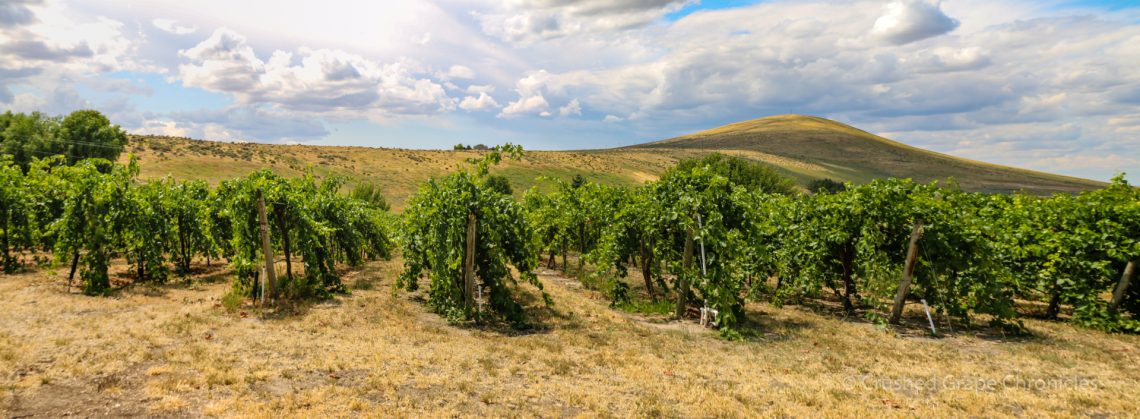
Candy Mountain (2020)
With just 110 acres of the total 815 acres of the Candy Mountain AVA under vine, this is the smallest AVA in Washington State.
Candy Mountain is close to Red Mountain, sitting just 4 miles to the east. There are 2 commercial vineyards in the AVA, Kitzke Cellars and Candy Mountain Vineyard. We had a chance to visit Kitzke Cellars with Seth Kitzke. His parents started the vineyard where Seth grew up, and he now makes the wine. He also makes wine under his own label, Upsidedown Wine, where he sources from multiple regions.
Seth walked us through the vineyard, showing us the Caliche soil, and pointed out one of the Missoula Flood boulders near the property, which was as big as a VW bus.
More on Candy Mountain

Goose Gap (2021)
Sitting south of Red Mountain and Candy Mountain on the south side of the 82 you find Goose Gap. It sits in the gap between Goose Mountain and the Candy and Badger Mountains.
The total area is a bit over 8,100 acres with 1,800 planted to vine. Vines here are planted on the north-facing slopes, so they ripen later. Elevations run between just under 600 feet to over 1,300 feet, meaning the vineyards near the top sit above the Missoula Flood line (which is at 1200 feet) This gives the vineyards variation in soil types.
The region has 2 vineyards and one winery.

Naches Heights (2011)
Northwest of the Yakima Valley, the Naches Heights AVA has distinct andesite bedrock. The AVA is on a plateau with elevations from 1,200 to 2,100 feet. Its altitude and location make it cooler than most Columbia Valley AVAs. It sits wholly above the Missoula Flood line, so you won’t find alluvial soils here. Here, soils are windblown loess.
We spent time at Paul Beverage’s Wilridge vineyard, which is farmed biodynamically. The views are spectacular, and we were lucky enough to catch sunrise there on 2 occasions.
From the top of the plateau, you can see the Cowiche Canyon. When we last visited around harvest, the landscape was dotted with vivid red sumac, mustard yellow rabbit brush, and the vivid green of vineyards within the tapestry of brown fall grasses.
You can read more about the vineyard in these posts.


Walla Walla (1984)
Walla Walla is a shared appellation spanning into Oregon. The region covers 300,000 acres with 2,933 planted acres 1,672 on the Washington side.
This region is rolling hills of wheat with scattered vineyards. Driving through part of the region once, I thought Michael and I were lost. It was hills of grain as far as the eye could see. The foothills of the Blue Mountains.
This AVA is home to many wineries, including some of the oldest in the state. There are around 120 wineries in the Walla Walla Valley AVA, and the city of Walla Walla is a great place to park yourself while you explore them.
In 2018, we first visited the region for the Wine Media Conference and became hooked.
We’ve visited large and small wineries in the region, and the spirit of community here is inspiring.
More on the Walla Walla Region
- Episode 4 – The Scenic Route Walla Walla & Caprio Cellars
- Episode 5 – The Scenic Route L’Ecole No. 41 and Walla Walla Wine history
- The Scenic Route Part 6 – Visiting Rioja in Washington and dinner at a gas station in Walla Walla
- WBC18 in Walla Walla the Sweeping Overview
- Armstrong Family Winery – The Journey to Washington
- The Valley Grove Vineyard and the future of Armstrong Family Winery


Lewis-Clark Valley (2016)
The Lewis-Clark Valley AVA is shared with Idaho, sitting on the Eastern border of Washington and along the Snake River. The AVA is temperate due to the low benchlands and steep canyons.
While the overall size of the AVA is 306,658 acres, with about ¼ of that in Washington, there are only 100 acres planted to wine grape total, with just 9 of them in Washington.
In addition to wine grapes, the region is known for fruit trees and table grapes.
It is named for the explorers Lewis and Clark.
For more information visit https://lewisclarkwine.com/

White Bluffs (2021)
Heading North along the Yakima River, you pass the White Bluffs AVA sitting east of the river. This AVAs soils are windblown silt and Missoula Flood deposits on top of ancient lakebed sediment, that is called the Ringold Formation. It is white in color, which is where the region gets its name.
What sets this region apart is the lack of basalt bedrock. The AVA sits on a plateau above the rest of the region, some 200 feet higher than the surrounding area, which, as we have seen in other regions, mean less frost pressure.
While the region has only 1 winery and 9 vineyards, you will find grapes from this region in 1/10 of the wines in the state.

Wahluke Slope (2006)
As we continue north in the Columbia Valley we reach Wahluke Slope.
Wahluke means “watering place,” and sits in an ancient alluvial fan. It sits in a curve of the Columbia River. A Google overhead shot shows an isolate swath of green bordered to the north by the Saddle Mountains, to the West and south by the Columbia river and to the east by the Hanford Reach National Monument.
As you zoom in you see crop circles and the green of other agriculture. You will find 20 vineyards here. There are 2 Wineries Fox Estate and Ginkgo Forest Winery and 3 custom crush facilities. Many of the large wineries in the state source fruit from the region.
The AVA covers an area of 81,000 acres with 8,932 under vine. The climate here is warm and red wines dominate. While the elevations run from 425 to 1,480 feet, most of the vineyards are below the 1000 foot mark.

Royal Slope (2020)
North of Wahluke Slope, still to the east of the Columbia River is Royal Slope. This AVA is north of the Saddle Mountains around the town of Royal City.
Covering an area of 156,389 acres with 1,900 under vine, the AVA is a south-facing slope of the Frenchman Hills that run 30 miles east-west. The average elevation of the AVA is 1,300 feet, making it cooler than the Wahluke Slope AVA to the south.
You’ll find 13 commercial vineyards and one winery in the Valley.
Ancient Lakes (2012)
North of Royal Slope, on the other side of the Frenchman Hills, you find Ancient Lakes. The area is named after a series of 35 lakes that remain from the Missoula Floods, which were formed by the huge Cordilleran Ice Sheet.
The canyons here are called “coulees” and were carved out by the floods. Many of the vineyards sit at higher elevations, allowing for large diurnal shifts that help the grapes maintain their acid while they are ripening. This makes this a prime location for growing white wine grapes, and in fact, it is the only AVA in Washington with more vineyard acres dedicated to white grapes than to red.

Rocky Reach (2022)
As we head further north, we travel up the Columbia River toward the Cascade Mountains. Here, north of Wenatchee, is the thin strip of the Rocky Reach AVA.
Steamboat Captains dubbed the region “Rocky Reach” in the 1800s because of the rapids here.
The soils here are covered in gavel and cobblestones from the glacial floods. These stones warm in the day and radiate heat to the vines at night. The bedrock here is made of silica-rich rocks with quartz and mica. As a result, the minerals for the vines are different.
The area encompasses 32,222 acres, with just 117 acres under vine. There are 8 vineyards, 2 owned by Rocky Pond Winery, which make up the largest part of vineyard plantings with their Double D Vineyard and Rocky Reach Vineyard. The winery acknowledges that the two sites, just 8 miles apart, have starkly different soils.

Lake Chelan (2009)
Sitting on the shores of Lake Chelan, this is currently the northernmost nested AVA in Washington. (The Columbia Valley overarching AVA does continue to the North.)
The lake is a narrow 50-mile glacier-carved lake. It is deeper than the deepest of the Finger Lakes in NY, reaching 1,486 feet. (Seneca Lake, the deepest of the Finger Lakes, bottoms out at 600 feet.) It is the third deepest Lake in the United States, sitting behind Crater Lake, Oregon (1949 feet) and Lake Tahoe (1645 feet).
Here, the bedrock is granitic rather than basalt. It is north of the Missoula Floods, but you find ash and pumice from the volcanos of the Cascades.
The climate of the region is affected by the Lake, the large body of water moderating the temperatures, making it cooler in the summer and warmer in the winter.
The vineyards are to the south and east of the lake. The AVA encompasses 24,040 acres, with 269 acres under vine.
For more on the Lake Chelan AVA visit their site at https://lakechelanwinevalley.com/about/lake-chelan-ava/
Head to WA Wine!
Visit the Washington State Wine Commission at https://www.washingtonwine.org/ For so much more information on Washington Wines! And don’t forget to celebrate #WAugust!

Robin Renken is a wine writer and Certified Specialist of Wine and WSET 3 Certified. She and her husband Michael travel to wine regions interviewing vineyard owners and winemakers and learning the stories behind the glass.
When not traveling they indulge in cooking and pairing wines with food at home in Las Vegas.

Check out our book series, “Tempting Spoonfuls” available through Amazon!
Inspired by the flavors and aromas in wines, these books create “tempting spoonfuls” of flavors to pair with wines.
“Tempting Spoonfuls – Pairing single bites with glorious wines” – Our first book paired wines from boutique wineries on the west coast, in California, Oregon, and Washington, with delicious spoonfuls.
This book is 60 pages, 18 recipes, lots of beautiful photos, and insights into some fantastic small wineries!
“Tempting Spoonfuls – small bites paired with wines from around the Globe” – This book takes us around the globe to explore 12 wine regions, a wine from the region, and then gives you a recipe for a pairing!
A slightly larger book at 104 pages, this time you learn about pairing with a type of wine from a region. Rather than a specific bottle, you can look for a style of wine from a region and feel confident that it will go well with the recipe pairing we provide. We give you 12 recipes, each to pair with a wine.
The goal is to make your mouth water and encourage you to create your own “Tempting Spoonfuls.”


Leave a reply