

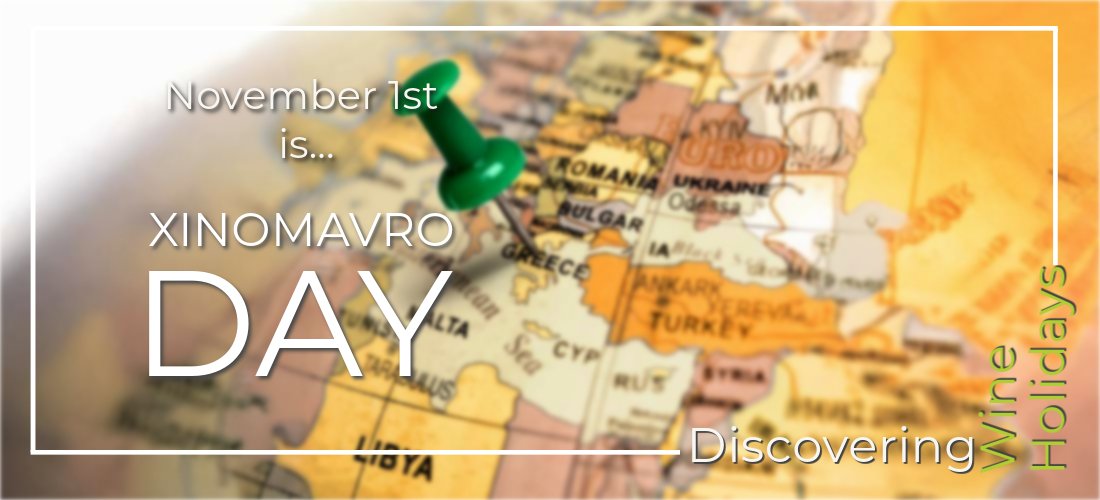
Xinomavro Day on November 1st!
Xinomavro is the primary red grape variety in Northern Central Greece. Saying it is the “primary” grape might be understating things a bit; this grape is planted everywhere in this region, and it is listed as one of the 3 most planted grapes in all of Greece.
That “X” is pronounced like a “Z”, which makes this grape pretty fun to say. I also have a friend with a cat by this name (luv that!)
Where to find Xinomavro
Primarily found in Greece, you find this grape in several appellations (or PDOs as they are known in Greece).
Naoussa
This is one of the most important PDOs in Greece, it was one of the first acknowledged in
In this appellation wines are made from 100% Xinomavro as a red wine that is either dry or off-dry.
Historic note on the region!
The Archaeological site of the School of Mieza, where Aristotle once taught, is located in Central Macedonia, around the city of Naoussa.
Amynteo
Lying north west of Naoussa, Amynteo, also makes wines of 100% Xinomavro, but in addition to reds, it is made into rosé and sparkling wines here.
Goumenissa
Also in Macedonia, this time to the northeast of Naoussa, you will find Xinomavro co-fermented with Negoska to make red wine.
Rapsani
Rapsani is located in Thessaly, a region south of Macedonia. Here, Xinomavro is co-fermented with Krassato and Stavrota to make red wines.


Xinomavro – the Diva
This is a demanding grape, needing just the right soil and climate (humid, but not too humid) and wanting lots of attention. It will grow out of control if not kept in check.
About the flavor and aromas
The name means “sour black,” which is pretty descriptive of this tart, dark grape.
You will find notes of licorice, anise, tobacco, and allspice layered on notes of strawberry, raspberry, rhubarb, rose petal, and plum. As it ages, you find dried fruits and tomato leaves added to the aromas.
This grape makes high-acid wines that age well and is sometimes compared to Barolo. However, due to its finickiness, it is sometimes compared to Pinot Noir. While the flavors develop during aging, the color sometimes drops out.
While this grape is most often made into red wine, its acidity also lends itself to rosé and sparkling wines.


What to pair?
Lamb koftas or domadakia if you want to keep it Greek. But this wine is often compared to Nebbiolo, so you can add to that list things you would pair with that wine, risotto, steak, and pasta.
Learn More about Greek Wines
Learn more about this and other grapes of Greece at https://winesofgreece.org
Or find more on Crushed Grape Chronicles


Robin Renken is a wine writer and Certified Specialist of Wine and WSET 3 Certified. She and her husband Michael travel to wine regions interviewing vineyard owners and winemakers and learning the stories behind the glass.
When not traveling they indulge in cooking and pairing wines with food at home in Las Vegas.

Check out our book series, “Tempting Spoonfuls” available through Amazon!
Inspired by the flavors and aromas in wines, these books create “tempting spoonfuls” of flavors to pair with wines.
“Tempting Spoonfuls – Pairing single bites with glorious wines” – Our first book paired wines from boutique wineries on the west coast, in California, Oregon, and Washington, with delicious spoonfuls.
This book is 60 pages, 18 recipes, lots of beautiful photos, and insights into some fantastic small wineries!
“Tempting Spoonfuls – small bites paired with wines from around the Globe” – This book takes us around the globe to explore 12 wine regions, a wine from the region, and then gives you a recipe for a pairing!
A slightly larger book at 104 pages, this time you learn about pairing with a type of wine from a region. Rather than a specific bottle, you can look for a style of wine from a region and feel confident that it will go well with the recipe pairing we provide. We give you 12 recipes, each to pair with a wine.
The goal is to make your mouth water and encourage you to create your own “Tempting Spoonfuls.”


Leave a reply