


Durella the grape – Durello the wine
Exploring Indigenous Italian Grapes
I love nothing more than discovering a wine grape that I have never heard of before. Italy is the perfect place to explore these types of grapes. There are over 400 indigenous wine grapes in Italy grown commercially, and there is no better way to get to know these grapes than a boots-on-the-ground visit to the regions.
We are pairing a Sparkling Durello with a rustic dish from the region, that we elevated with other ingredients that would be found locally. (The recipe is at the bottom)
This month, the #ItalianFWT writers are diving into Indigenous grapes, led by Cam at Culinary Cam. You can read her Preview Post here.
You will find links to my colleagues’ work at the end of this post! If you want to join the conversation, we will be gathering on Threads on Saturday, March 9th, at 8 am Pacific time (a more reasonable 11 am for those of you on the East Coast). You’ll find us by following #ItalianFWT or @culinary_cam on Threads.
*This wine was provided to me as a media sample from the winery.
No other compensation was received, and all opinions are my own.

Searching for Native Grapes
When we knew we were heading to Northern Italy in the fall of 2022, I wanted to find and visit wineries and winemakers working with some of these indigenous varieties. I reached out to Sheila at VeroVino in California. She lives in Bologne and imports wines from small wineries to the US.
Sheila carried a Monti Lessini DOC Metodo Classico Brut from Sandro de Bruno. Sandro de Bruno is not a small winery per se. They produce around 120,000 bottles annually, much of which is Soave. Sheila connected us with the winery, and we met and spoke with Sandro Tasoniero, who founded the winery in 2002 with his wife, Marina Ferraretto.
We wrote a bit about this wine last year. Monti Lessini – The Sparking Wine for Star Crossed Lovers.

A conversation with
Sandro Tasoniero
of Sandro de Bruno
I wanted to get into more of our conversation with Sandro. We spoke with him in the beautiful cellar at the winery. At the time of this trip, my Italian was extremely limited, and Bruno spoke little English, so we conducted the interview in Italian. Greta, the winery marketing person, translated my questions, and Bruno answered them in Italian. We recorded the interview, but translating…
I transcribed and translated the interview (via Adobe & Google). Looking at the translated document, I am reminded that Italian is a Romance Language. The phrasing and thought process here is lyrical, and imagery and metaphors dot the translation. It is not as simple as a direct word-for-word translation. It’s really very beautiful.
We were in the center of the cellar in a new room that had recently been completed. This room was built with walls of sparkling wine bottles; the ceiling vaulted in brick. Lit candles sat on a wooden table, and barrels held bottles in each corner. Greta, the PR person for Sandro de Bruno, led us in and got us set up, and then Sandro joined us.
“Sandro de Bruno” means Sandro of Bruno (son of). Sandro’s father, Bruno, was an influence here.
Sandro’s grandfather began making wine in the early 1900s. He went to the United States to work for about 6 years, then returned to Italy in 1927 and purchased land to cultivate wine and olives, selling to the local osterias. Sandro’s father also made wine, and Sandro says he was born in the cantina.
The winery where we met him was built in 2002 and sits in the Soave region. This is northeast of Verona in the Veneto, where the Po Valley ends and the hills begin. These hills are volcanic in origin.
The hill where their Durella vineyard sits has old volcanic soil and marine sediment. This, Sandro tells us, is what makes this territory unique. 40-50,000 years ago, this entire territory was a lake. Fossils of fish and clams have been found.
Durella is an autochthonous vine indigenous to the area between Verona and Vicenza. It is cultivated above 400 meters on black soils. Sandro says, “The vines dig deep and are able to extract the minerality that we always feel in this wine.”
The name “durella” means “hard” and refers to the thick skins of these grapes.
Sandro’s Durella vineyard has soil with high mineral content and fresh air, far from the factories below in the valley. Breezes from the mountains to keep the vines healthy. The region is also dotted with biodiversity, with mixed crops and forests separating vineyards. “This combination between woods and viticulture creates a perfect environment.”
When we visited in the fall of 2022, they had just come through a summer of extreme drought. Many vineyards had no rain and really suffered. But Sandro’s Durella is in the high hills, and the vines’ roots go deep into the volcanic soil, allowing them to find water. The roots in his vineyard dig deep because he doesn’t use chemical fertilizers, which when spread over the surface of the vineyard don’t give the vines a reason to dig deep into the soil to search for nutrients.
Sandro’s vineyards are sustainable and use only organic fertilizers and treatments.

“Experience has taught us that, in this way, as well as not hindering the natural biorhythms of plants and living beings, over time, we obtain better results in terms of quality and health for the consumer, as well as socially and ethically just, integrating the well-being of people with that of the earth.”
Fun Facts on Durella
Sandro tells us that Durella grapes and wine are so high in malic acid and vitamin C that it was used to prevent scurvy.
In the 1200s, the Venetians traded this grape with the Norwegians for salt cod or “baccala.”
The Italians used Durella as a curative, which was sold in pharmacies.
This grape has been growing in this region for a thousand years and has adapted to the local conditions.
Durella in the vineyard is a hearty rustic grape with thick skins, immune to disease. But in the cellar, Sandro tells us, it becomes delicate and must be treated with velvet gloves.


Sparkling Durella
Lessini Durello & Monti Lessini
On average, most Italian sparkling wines are aged 12, 18, or maybe a few to 24 months. Sandro feels Durello needs at least 18 months before it can be appreciated. For him, it is after 3 years of refermentation in the bottle, that this wine becomes intriguing.
Within the Consorzio Tutela Vino Lessini, there are 2 Sparkling wine denominations. Both are based on Durello, but the Lessini Durello is made in the Charmant Method, the Martinotti or tank method, like much of Prosecco, or the Monti Lessini, produced in the Metodo Classico.
Bruno’s sparkling wines are in the Metodo Classico, the Traditional Method like Champagne, where the second fermentation happens in the bottle.
They riddle by hand here. This is the method of turning the bottle to concentrate the dead yeast cells in the neck of the bottle. They have a technique of remuage (another term for riddling). Here they take the bottle from the rack, by the neck and swing it neck down in a circle above their heads. This motion dislodges any lees (yeast) that is stuck to the sides of the bottle, working to concentrate it into the neck of the bottle, so that it can be removed.
The vineyards are relatively close to the winery, so they arrive at the cellar within a few hours after picking the grapes.
The grapes macerate for 10 to 15 hours in an inert environment without oxygen before they are pressed. Then, they ferment at low temperatures with a combination of indigenous and purchased yeast. Fermentation lasts about 4-6 weeks, and the finished wine is decanted.
In June, the transformation phase begins in the first bottles, and they start the second fermentation, which lasts at minimum 3 years. The bottles are riddled for about 10 days, drawing the yeast down into the neck of the bottle, then they are disgorged and corked. They are held for a few more months for refinement before going on the market.
Tasting with Sandro
As we sip with Sandro, he speaks of the minerality and freshness that you get immediately and the aromas of almond blossoms. I’ll be honest; I have never had the opportunity to be among almond trees in bloom, but I’ll take his word for this. The wine has notes of lemon and grapefruit, and he says with long refinement, you get notes of chamomile. There is also a wonderful mineral note to this wine.
When we ask about things to pair this with, he suggests it for aperitivo with cheese or fried foods. On their site, they have a lovely suggestion for pairing with a “Fassona” beef tartare topped with an egg that looks delicious.


Into the Vineyard
Sandro took us out into the vineyard. To see the soils and the vines, oh, and the views. The durella enjoys some spectacular views.
We stood 600 meters above sea level (almost 2000 feet). You can look down and see the Po River Valley below. To the west is the Valpolicella region.
The region is divided into 15 Crus or sub-zones. The Sandro de Bruno Vineyard is in the Santa Margherita subzone, formerly called Costalberto. This is the southern limit of the Durello region in the Roncà municipality. You find volcanic soils of columnar and flow basalts here.
The vineyard is on Mount Calvarina’s volcanic slopes.
He is right. The air here is clear and fresh. He finds a durella grape missed in the harvest, and I get to taste it. It is thick-skinned and high in acid, but of course, as it has been left on the vine, it is sweeter as the sugars have further developed.
One of the great things about durella. Is that it is a high-acid grape, so while other varieties need to be harvested early for sparkling wine, while their acids are high, durella can stay on the vine longer and come to full phenolic ripeness. It retains its acid but has all the complexity of a fully ripened grape. With the thick skins of this grape, phenolic ripeness in the skins gives the wine a bolder personality.


Sandro de Bruno
Monti Lessini Metodo Classico
Extra Brut 60 Mesi
Grown between 450 and 600 meters above sea level (between 1450 and 1960 feet) on Mount Calvarina, this wine is 90% Durella and 10% Pinot Blanc, which Sadro says gives roundness. The vines in this 4-hectare vineyard average 35 years in age.
Harvested in late September, the grapes are destemmed and cold soak in a “closed static press for 12/18 hours, in nitrogen saturation.” It ferments in stainless steel at low temperatures and then stays on the lees for 8- 12 months with weekly bâtonnage. It ages in the bottle on the lees for 60 months before disgorgement and is held for 5 to 6 months before release.
The wine was sublime. Durello brings lots of flavor to the wine. The bubbles were tiny and persistent. There are notes of yellow fruits, stone fruit, tropical, light notes of freshly baked rolls, and a floral note. There are mineral notes of flint and saline. It is complex and beautifully integrated.
(This wine garnered 95 points from Wine Enthusiast)
Sandro offers this sparkling wine aged 36 months, 60 months, and now 100 months.
You can find his wines in the US at veroVino https://verovino.com/sandro-de-bruno-soave-verona-organic-italian-winery
The 36-month-old retails at $34.99.
The 60-month is currently on Pre-Order at $41.99.


Pairing Sandro de Bruno
Monti Lessini Durello
with Elevated Gnocchi Sbatùi
(or Gnocchi Malga)
I pondered creating the Fassona tartare, but then I came across Gnocchi Sbatùi or Gnocchi di Malga. This dish celebrates the local dairy products.
The herdsmen made these when they were up in the pasture with their herds from May to September. Isolated and staying in the small mountain huts, this was a quick and easy meal to prepare over the fire.
This dish, made traditionally, is now on the Italian National List of traditional Agri-food products as of February 15th, 2022, and is officially called Gnocchi della Lessinia.
The word Sbatùi refers to the beating of the mixture for the gnocchi. Traditionally, the gnocchi is made with local soft wheat flour and water heated to about 75 degrees Celsius, beaten together vigorously, then dropped by spoonfuls, or cut from a board into boiling salted water. The gnocchi are scooped out when they float to the surface and bathed in local melted butter, then topped with the local cheese Monte Veronese.
These days, Grano Padano is often used with or instead of the Monte Veronese.
Sadly, I was not able to find Monte Veronese or Grano Padano. So, I will not use the official “Gnocchi della Lessinia” name for my version.
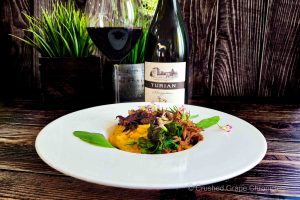
We took this rustic dish from the Lessini Mountains of Italy and zhuzhed it with grilled radicchio, orange, basil citrus dressing, and a panko gremolata.
I must admit, it came out even better than I expected! It is stunning with the colors, and a bite with all the components is heaven! It was also spectacular with the wine.
A bite of the food with this wine brought out the almond notes and accentuated the citrus notes in the dish, cutting through the richness of the gnocchi, butter, and cheese. The bit of bitter almond note, paired with the grilled radicchio.
This wine is glorious. Find a bottle and enjoy it! Maybe give my pairing a try! The recipe is below.

More from the #ItalianFWT writers
There are so many Italian grapes! You’ll find the writers discussing Grechetto, Frappato, Brarachetto, Merera, Grillo, and Zibibbo, among others!
Don’t forget to join us on Threads on Saturday, March 9th (hey, it’s my birthday!) at 8 am Pacific, 11 am Eastern, or 7 pm if you are in Istanbul with Andrea! Follow #ItalianFWT to join the conversation!
- An Umbrian Grape with Greek Origins: Cantina Roccafiore Grechetto di Todi Fiordalis + Pesce alla Ghiotta by Culinary Cam
- BI.VI.SI.: Revitalizing Sicily’s native, ancient vines for forgotten flavors like Frappato by Wine Predator…Gwendolyn Alley
- Brachetto: A Piemontese Grape Meant for Food! by Keep the Peas
- Castello di Grumello Medera & Casconcelli by The Quirky Cork
- Pasta, Wine, and a Cookbook Review by A Day in the Life on the Farm
- Sicilian Wine Grapes: Grillo and Frappato by Cooking Chat
- Sicily’s Zibibbo Grape with Fish Cakes by Vino Travels
- Unlock the Beauty of Mexican Wines: The Fusion of Italian Indigenous Grapes by Our Good Life
- Pizza wine! Fresh, fruity and made from native Italian grapes by My Full Wine Glass
- Ciliegiolo, Great Wines for Spring by Avvinare by Avvinare
References & Resources
- https://www.sandrodebruno.it/en
- https://verovino.com/sandro-de-bruno-soave-verona-organic-italian-winery
- https://www.larena.it/rubriche/wine-food/gli-gnocchi-della-lessinia-e-il-pero-misso-inseriti-nel-patrimonio-tradizionale-del-veneto-1.9324809
- https://wineandtravelitaly.com/food/monte-veronese-pdo/
- https://www.carugate.it/en/geography/lessini-durello
- https://winewitandwisdomswe.com/2023/06/05/dispatch-from-the-lessini-mountains-and-the-monti-lessini-doc/
- https://montilessini.com/cru-del-durello/
- https://montilessini.com/

Gnocchi di Malga with grilled radicchio and orange salad
We took this rustic dish from the Lessini Mountains of Italy and zhuzhed it up with a grilled radicchio, orange, a basil dressing, and a panko gremolata.
The traditional version of this dish is now called Gnocchi della Lessinia and is listed in Italy's National list of Traditional Agri-food Products.
Our version is a riff on this, as we didn't have access to butter and cheese from the region.
This pairs beautifully with a Lessini Durello Metodo Classico wine from this area outside of Verona.
Ingredients
Gnocchi
- 2 cups flour
- 1 cup water
- 1/3 cup half-n-half
- 1 tbsp salt
- 1/4 cup of unsalted butter melted
- 1/4 cup of shaved Parmigiano Reggiano
Radicchio Salad
- 1/2 head of radicchio
- 1 orange supremed
- 2 tbsp olive oil
- 1/2 tsp salt
Basil dressing
- 1 cup of fresh basil
- 2 oz can of anchovies
- 1/4 cup fresh orange juice
- 1/4 cup fresh meyer lemon juice
- 1 tbsp orange zest
- 2 cloves of garlic minced
- 1/4 cup walnuts
- 1/3 cup olive oil
Panko Gremolata
- 1/3 cup panko breadcrumbs
- 1 tsp meyer lemon zest
- 1 tsp minced garlic
- 1/2 tsp dried thyme
- 1 tbsp fresh sage finely chopped
- 1/4 tsp salt
- 2 tbsp butter
Instructions
- Gnocchi
- Heat your water and 1/2 and 1//2 to 70° C (158° F)
- Add to the flour in a large bowl and beat vigorously to remove any lumps
- Heat a pot of water to boiling
- Add 1 tbsp of salt
- Add your batter, either by the spoonful or by cutting off of a board
- When the gnocchi rise to the surface, scoop them out into a bowl
- Add the melted butter and cheese and mix gently to coat.
- Radicchio
- Cut the half of radicchio into 4 wedges.
- Toss with olive oil and salt
- Grill on one side for 3-5 minutes
- Slice into smaller slivers
- Dressing
- Add all dressing ingredients to a blender and blend until mostly smooth.
- Gremolata
- Melt the butter in a small pan.
- Add all ingredients and cook on medium heat, stirring often, until the crumbs brown slightly.
- To assemble
- Place the gnocchi in the bottom of the individual serving bowl.
- Top with a bit more cheese
- Dress one side with the radicchio in a crescent shape
- Top with orange sections
- Drizzle with the dressing
- Sprinkle with the Panko Gremolata
Notes
- If you are able, by all means, use Monte Veronese cheese and/or Grano Padano.
- You don't have to use any milk in this. You can use all water if you like.
- I am sure that regular lemon would have been fine in this dish. I just prefer the softer notes of Meyer Lemon.
- Adjust the herbs in the Gremolata if you like. I would have used fresh thyme if I would have had it.
Nutrition Information
Yield
2Serving Size
1Amount Per Serving Calories 1651Total Fat 105gSaturated Fat 35gTrans Fat 1gUnsaturated Fat 65gCholesterol 140mgSodium 5967mgCarbohydrates 148gFiber 9gSugar 27gProtein 33g
Nutrition information isn’t always accurate. You will have extra gemolata and dressing, so it will be fewer calories.

Robin Renken is a wine writer and Certified Specialist of Wine and WSET 3 Certified. She and her husband Michael travel to wine regions interviewing vineyard owners and winemakers and learning the stories behind the glass.
When not traveling they indulge in cooking and pairing wines with food at home in Las Vegas.

Check out our book series, “Tempting Spoonfuls” available through Amazon!
Inspired by the flavors and aromas in wines, these books create “tempting spoonfuls” of flavors to pair with wines.
“Tempting Spoonfuls – Pairing single bites with glorious wines” – Our first book paired wines from boutique wineries on the west coast, in California, Oregon, and Washington, with delicious spoonfuls.
This book is 60 pages, 18 recipes, lots of beautiful photos, and insights into some fantastic small wineries!
“Tempting Spoonfuls – small bites paired with wines from around the Globe” – This book takes us around the globe to explore 12 wine regions, a wine from the region, and then gives you a recipe for a pairing!
A slightly larger book at 104 pages, this time you learn about pairing with a type of wine from a region. Rather than a specific bottle, you can look for a style of wine from a region and feel confident that it will go well with the recipe pairing we provide. We give you 12 recipes, each to pair with a wine.
The goal is to make your mouth water and encourage you to create your own “Tempting Spoonfuls.”




12 comments
Leave your reply.