


Cabernet Sauvignon is the dominant grape in Bordeaux on the Left Bank and in Napa Valley. It is the most popular steakhouse wine, rich and deep.
In Bordeaux, vineyards are typically between 30 and 60 feet above sea level, with some reaching as high as 130 feet.
Napa Valley runs from a mere 17 feet above sea level in the south to 400 feet in Calistoga at its northern end. Of course, vineyards run up into the Vaca and Mayacama Mountains, so you can find Cabernets growing at 2,100 feet or so.

The Cabernets we were tasting come from the Southern Hemisphere in Argentina where they grow in the foothills of the Andes. This is the Tupungato Valley, at 4000 feet above sea level. Does that change the wine?
Well, there are some basics that affect the vines. Higher altitude increases UV exposure, which can cause the grapes to have thicker skins. This leads to more flavor in the wine.
Temperatures are also cooler, which leads the grapes to ripen more slowly. This preserves the acidity in the grapes as they ripen. This keeps the wines tasting fresh and can increase complexity.
Then, there is the Wind Factor.

Zonda Winds
While wind is not often the first thing we look at in a vineyard, it can significantly impact the grapes. The Uco Valley in Argentina is known for its Zonda winds.
Zonda Winds (also called foehn winds in the Alps) are dry and warm and blow down the eastern slopes of Argentina’s Andes Mountains.
Joaquin Hidalgo, a noted wine journalist specializing in South American wine regions, wrote a fascinating article for the Wines of Argentina Blog on the characteristics of this wind and how it affects the vineyards. (you can look forward to more insights on South American vineyards and wines from Joaquin when we share with you the Coastal Chilean Wines we tasted with him last month!)
When these winds hit in September or October, the warm air causes the vines to kick off their growth. But the winds get stronger and warmer, he notes, in October (spring in the Southern Hemisphere), the gusts are up to 60 miles per hour and the temperatures are as high as 104 degrees Fahrenheit in the late afternoon. But behind this comes a cold front that will drop temperatures and make frost an issue for those new buds.
Winds in the Uco Valley
The Zonda Winds are most intense in the Uco Valley. This valley sits near the Andes’ highest peaks, which reach 20,000 feet. The Uco Valley sits between 4,000 and 5,250 feet above sea level.
As Joaquin mentioned, these winds run from August to October, late winter into Spring in the Southern Hemisphere. This is the time when the vines are coming out of their dormancy, and they are fragile.
Rodrigo Serrano, Winemaker at Domaine Bousquet, explains how this affects their vines. The warm air speeds up the flowers and shortens the time that they are receptive to pollen. This means fewer fertilized flowers and less fruit.
That cold air that follows the winds? Yep, it will decrease fruit also if there are frosts, which Domaine Bousquet sees more often now due to climate change.
The dry air, while it would be great while the fruit was setting to lower disease pressure in the fall, is not as welcome at this time of year. Humidity can drop to 0%, and the flowers will dry out, again decreasing berry set and meaning less fruit.
Then you have shatter, the effects of the push of the wind on the flowers which causes them to break and blow away.
At Domaine Bousquet, they expect to see these strong Zonda winds 5 to 6 times each year. But climate change has made this more erratic. They prune later in the season to delay bud break and protect as much of their crop as possible. The problem is that with climate change, these winds can be seen as late as December and January.
They gathered information in the vineyard after the Zonda Winds and found that these winds decreased yields by up to 30%.

The positives
All this sounds pretty horrible, doesn’t it? The truth is that through the Zonda winds, they have a bit of natural selection in the grapes they harvest. They have fewer grapes on the vines, but these grapes are of higher quality. With the combination of high altitude and the sandy, desert-like soils, which lower disease pressure and the need for chemicals to keep the vines healthy, they are able to create wines with both depth and freshness.
We mentioned the increased flavor due to the day-to-night temperature shifts. This is the grapes, keeping themselves warm with a thicker, heavier coat. That coat, their skin, is full of flavor.
The Wines
Gran Bousquet Organic Cabernet Sauvignon 2021
A blend of 85% Cabernet Sauvignon and 15% Malbec
This wine incorporates fruit from four types of soils, ranging from sandy to stony, which allows for additional complexity. The grapes for this wine are hand-selected bunches from the original “home” vineyard that Jean Bousquet planted in 2000. These are often the last grapes to be harvested, and the extra “hang-time” allows the grapes to develop additional richness.
The grapes ferment for 12 days and another 8 days of maceration on the skins. It then ages 10 months in ½ new and ½ used French Oak.
14.5% abv – $25 SRP
My tasting notes:
Deep Ruby in color with pronounced notes of red currant, black cherry, and plum, plus dried herbs, coffee, spice, licorice, dried fruit, and smoked meat, with a long pleasant finish.


Ameri Single Vineyard Organic Cabernet Sauvignon 2021
This wine is named for Labid al Ameri, the co-owner of Domaine Bousquet, and it is only made in exceptional years. It is 100% Cabernet Sauvignon. This vineyard is the highest on the property at 4,125 feet.
This is not only a single-vineyard wine but also a wine made of selected hand-harvested clusters. It is fermented with native yeast for 14 days and macerated for 20 days in oak barrels. Each barrel is pressed manually separately. The wine is aged in 65% new oak and 35% used for 12 months.
They make just 500 cases of this wine. Each bottle is numbered.
14.5% abv – $36 SRP
My Tasting Notes:
Deep in color with more violet notes than the Gran Cabernet. The nose has intense notes of crushed wet rock, black currant, black cherry, and fig. Additional smoke and fresh tobacco notes with a powdery cocoa note on the finish.
This wine opens up beautifully, rounding and mellowing.
Both of these wines are perfect “cooking” wines—those that you open up when you start cooking, pour a glass, sip while you cook, and enjoy the evolution as the wine opens up. Or…you could go the more conventional route and decant them.
The Pairing

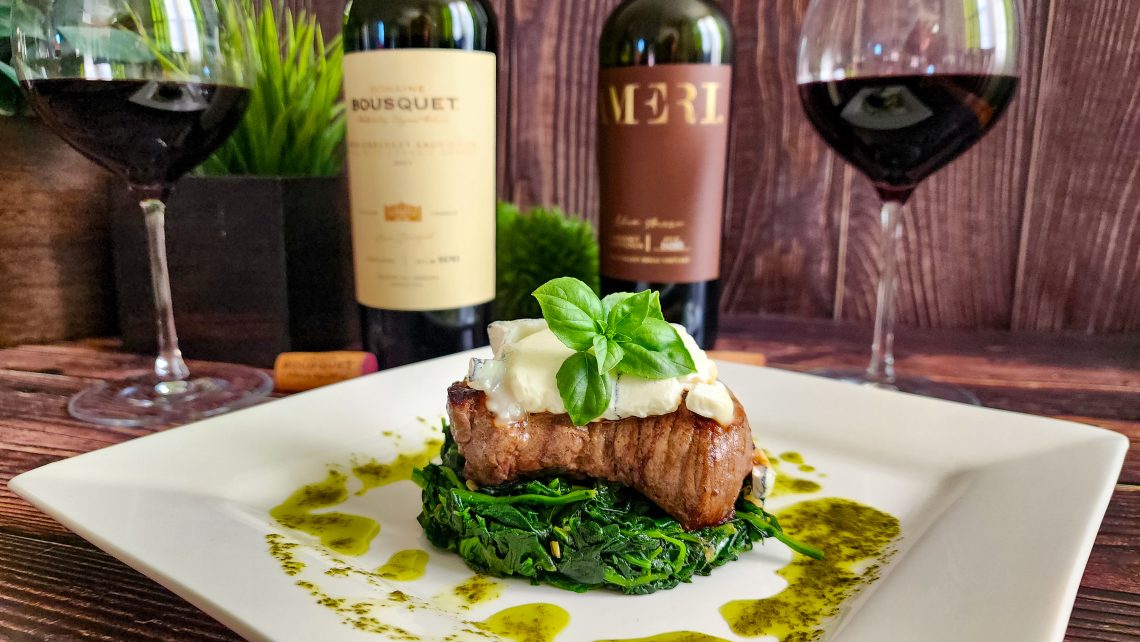
Sirloin steaks on roasted garlic spinach topped with Humboldt fog cheese
Allow the steaks to come to room temperature for about 20-30 minutes. Season with salt and pepper and place in a rod iron skillet preheated with olive oil.
Cook the steaks for 2 min per side, and then place in the oven at 400 degrees Fahrenheit. Keep checking every 3-4 minutes with a meat thermometer. It should reach 125 to 130 degrees for a rare to medium-rare steak. Allow it to then rest for 5 minutes (with the slice of cheese on top) under tented foil. Serve it on a bed of spinach sautéed in bacon fat with crushed roasted garlic and seasoned with salt, pepper, and a bit of lemon juice. Drizzle a bit of basil oil around the edge and top with a sprig of fresh basil.
More on the Wines of Argentina and Domaine Bousquet

Robin Renken is a wine writer and Certified Specialist of Wine and WSET 3 Certified. She and her husband Michael travel to wine regions interviewing vineyard owners and winemakers and learning the stories behind the glass.
When not traveling they indulge in cooking and pairing wines with food at home in Las Vegas.

Check out our book series, “Tempting Spoonfuls” available through Amazon!
Inspired by the flavors and aromas in wines, these books create “tempting spoonfuls” of flavors to pair with wines.
“Tempting Spoonfuls – Pairing single bites with glorious wines” – Our first book paired wines from boutique wineries on the west coast, in California, Oregon, and Washington, with delicious spoonfuls.
This book is 60 pages, 18 recipes, lots of beautiful photos, and insights into some fantastic small wineries!
“Tempting Spoonfuls – small bites paired with wines from around the Globe” – This book takes us around the globe to explore 12 wine regions, a wine from the region, and then gives you a recipe for a pairing!
A slightly larger book at 104 pages, this time you learn about pairing with a type of wine from a region. Rather than a specific bottle, you can look for a style of wine from a region and feel confident that it will go well with the recipe pairing we provide. We give you 12 recipes, each to pair with a wine.
The goal is to make your mouth water and encourage you to create your own “Tempting Spoonfuls.”


Leave a reply