


Bubbles seem natural for the holidays. Sparkling wines are joyful and bring an extra bit of levity to holiday gatherings. Of course, there are many types of sparkling wines, but today we will focus on Prosecco.
Prosecco
Prosecco is an Italian sparkling wine made from the grape Glera. It is grown in the Northwestern corner of Italy, in the regions of Veneto and Friuli-Venezia Giulia.
Here, the Glera grape, which was previously called “Prosecco”, the same name as the sparkling wine, thrives on steep, lush hillsides. Those steep hillsides can often make harvesting treacherous. In fact they refer to it here as “heroic viticulture.”
These joyful Italian bubbles are typically made in what is known here as the Martinotti method. In France it is known as the Charmat Method and elsewhere they call it the tank method. But I only said “typically”. Today we will try wines from Bellenda, made in several sparkling wine methods.


Traditional Method Sparkling Wine
Champagne is perhaps the most notorious of Sparkling Wines. It is produced using the Traditional Method (Méthode Champenoise). In this Method, the wine is fermented, then bottled, and additional sugar and yeast are added to initiate a second fermentation. This created a bubble in the wine, trapped in the bottle, producing that fabulous fizz.
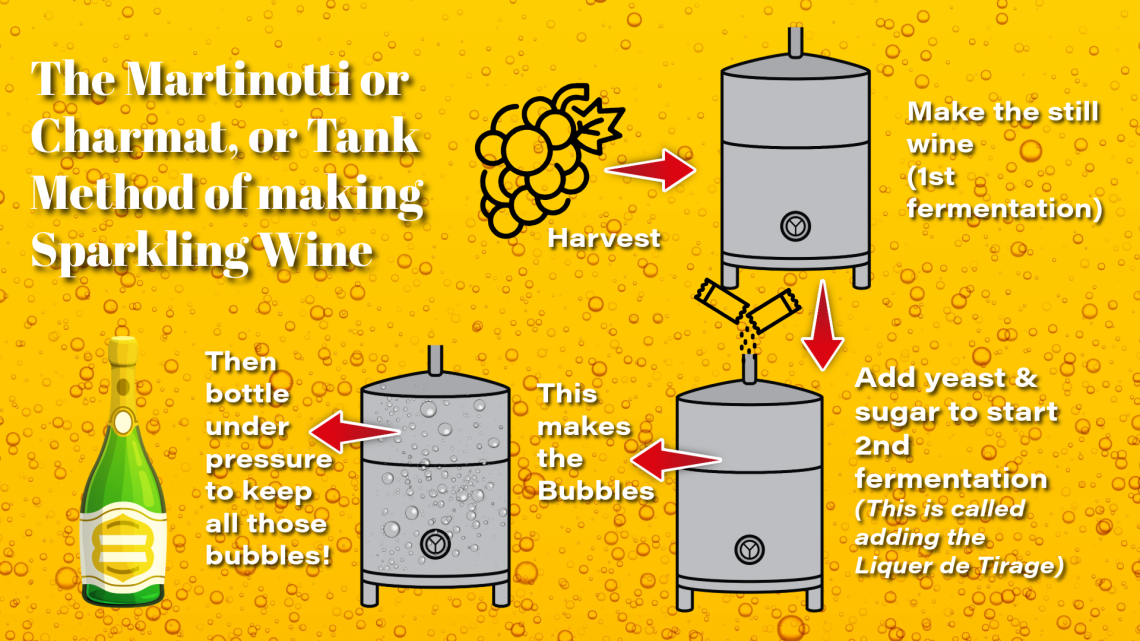
Charmat, Martinotti, or Tank Method Sparkling wine
In this Method, the 2nd fermentation takes place in a pressurized tank. Again, you get bubbles, but perhaps not as small as with the Traditional Method, and with a little less pressure.

Ancestral Method Sparkling wine
Here, the 2nd fermentation occurs when the wine chills before fermentation is complete. When it warms again, the yeast resumes fermentation.
This is how bubbles first began. The wine was bottled after the weather got cold and fermentation stopped. Those bottles sat, and then, in spring, when the temperature rose, fermentation kicked off again. In the south of France, they liked this happy accident and began chilling the wines in streams in winter to create it. (Yes, they made sparkling wine before Champagne)

Prosecco from the Conegliano Valdobbiadene DOCG
One of the most famous regions for Prosecco is the Conegliano Valdobbiadene DOCG. Located in the Veneto, this region encompasses steep, lush hillsides and some flatter plains that run between the cities of Conegliano to the East and Valdobbiadene to the west.
Within the DOCG, there are 43 Rives, smaller regions, you can think of them as Crus if you like. The region is a mosaic of soils, aspects, and altitudes, so these Rives take into account the differences in all these aspects from one small area to another.


Bellenda
The wines we are looking at today come from Bellenda. We tasted a few of their sparkling wines a couple of years ago and participated in a Zoom with winemaker Umberto Cosmo. This fall, I had the opportunity to join another Zoom with him to discuss the regions that inform their wines.
Umberto and his brothers founded this winery in 1987 from a family vineyard. Their estate and vineyards are located in Carpesica, a town north of Conegliano in the Eastern part of the Conegliano Valdobbiadene DOCG. Carpesica is one of the 43 Rives I mentioned earlier.
(Look to the East side of the map for Conegliano,north of that you will find the Carpesica Rive)

Sparkling wines of Bellenda
You will notice that I said “Sparkling wines”, not Proseccos. That is because at least one of these wines falls outside the Conegliano Valdobbiadene DOCG, instead located within the larger Prosecco DOC, and one is not officially a Prosecco at all, but rather a non-filtered sparkling wine made in the ancestral Method. Let’s begin with that wine.
Bellenda Con Alti/ Non Filtrado
Not a Prosseco, while made with Glera, this wine is made in the Ancestral Method. It is bottle fermented with no added sulphites.
This wine focuses on authenticity. This ancient method of making sparkling wines allows the aromas to spill through. This has a single fermentation and the lees (the dead yeast cells) fall to the bottom of the bottles, with some mixing and incorporating into the wine, making it a bit hazy. This style is often called a “Pet Nat” or “Petulant Natural”, or, here in Italy, you may hear it referred to as Col Fondo.
The wine is dry and full of tree fruits like pear and apple with notes of honeysuckle, with a bit of mint and the savory richness of rosemary.
The name “Con Alti” comes from a small town in Vittorio Veneto. North of here you find Mt. Pizzoc and Mt. Visentin, between the two is the Fadalto saddle. The soils in this vineyard are limestone driven with moraine from the ancient Piave glace that came through the Fadalto saddle.

The vines are grown in three different methods. Some are on simple vertical trellis. Some are trained in the traditional Bellussera method with radiating spokes. This method, introduced by the Bellussera brothers at the endo fht e19th century, has tall poles connected by wires in a radial pattern. This allows the vines to maximize sun exposure and allows the grapes to hang loose beneath the trellis, allowing air to pass through protecting them from downy mildrew. The final method is even older, where the vines are supported by trees (the truly ancient method). With all these trellising methods, the grapes are obviously hand harvested.
While we are leaning into natural wine making with this style, the grapes are de-stemmed, gentle pressed and have a short maceration with fermentation. The still fermenting wine, near the end of fermentation is bottled while it still has a bit of residual sugar, which causes the additional fermentation in the bottle to give you those bubbles.
If you prefer your wine clear (not hazy), the winery suggests decanting it gently into a carafe before serving.

Fratelli Cosmo Prosecco DOC
Extra Dry
This wine is made in the Tank or Martinotti Method.
These grapes come from the hills of Treviso, northwest of Conegliano and Valdobbiadene. They come from Cordiano, Sarmede, and Cappela Maggiore, where the vineyards sit between 120 and 240 meters in altitude.
These vines are planted in the Sylvoz system. (That one I had to look up!). Developed by Carlo Sylvoz, this method uses a high trellis (1.5 to 1.8 meters high) for the cordon, with a lower trellis wire to which the fruiting canes are tied. This method is considered better suited to fertile soils and cooler climates. It maximizes the number of buds and, as such, the amount of fruit per vine.
While this method is often used for mechanized harvesting, these vines are all hand harvested.
The name here is Fratelli Cosmo or “Brothers Cosmo”, you can see the brothers in the photo below!

We received a split as the distributor was out of stock of the full size bottles (a good problem to have!). It was small enough for Father Christmas to hold for us for the photo!
The label for the Fratelli Cosmo is done by an artist in Australia who worked with their importer to develop it!
This is the newest wine on our tasting and you get notes of yellow apple, apricot and peach.
San Fermo Bellenda Valdobbiadene Prosecco Superiore DOCG 2024 Brut
San Fermo is the wine they have been making since the beginning, and is their most important wine. This allows us a minute to fill you in on the Bellenda story.
In 1986 they took over a vineyard that had been run by their Grandfather. They changed the approach to culivating vines, leaning into agro-forestry, maintaining the woods and the biodiversity in their area. The region they are in is 60% woods, 30% vineyards and 10% people and other agriculture. They added sheep to their vineyard and property. Umberto lives in the center of the vineyard and raised his children here. All their energy comes from solar and the glass they use for bottles is recycled.
The San Fermo shows the characteristics of the glacier driven moranic hills of the area, giving the wine more body than you might find in other local wines.
The name San Fermo comes fro the country church next to the vineyard in the Carpesica area. This area has limeston-clay soil with rich morainic deposits. The vines are primarily trained to the Sylvoz method (mentioned above.)
After harvesting in late September, the clusters are de-stemmed and gently pressed. It ferments and rests on the lees in tank for 3 months. 2nd fermentation takes place in the tank via the Martinotti method.
This is a wine that will age a bit continuing to develop for at least 4 years.
The nose on this has a bit of savory, minerally notes.


Sei Uno Bellenda Valdobbiadene Prosecco Superiore DOCG Rive di Carpesica Cru
This wine is made in the Traditional Method, or Metodo Classico, as it is called in Italy.
Sei Uno spends 15 months sur lie (on the dead yeast cells) in bottle for it’s second fermentation. The wine is disgorged and then spends another 6 months aging before release.
Here you get notes of apple and hazelnut, with bits of mint and the savory note of rosemary.
They first made Sei Uno in 1961 for an event for the family. So this wine has a long and very personal history.
Again, the grapes come from the Carpesica Rive with the vines trained to the Sylvos and Cappuccina methods. (Yep, I went to look up Cappuccina) The Cappuccina method is often known as Double Inverted Guyot. Here two canes are chosen and trained to either side on lower wires, forming “U” shapes. This maximizes canopy volume for vigorous vines and is popular for Glera grapes.
Holiday Pairings for Prosecco
The thing I love most about sparkling wine is how joyfully it pairs with food. These wines tend to be high acid, and the bubbles cleanse your palate with every bite. This means that every time you take a bite of something delicious, it tastes as wonderful as the first bite!
Many people like to start a meal with sparkling wine, but honestly, you could enjoy it throughout the meal and enhance your tasting experience!
There are so many options! You will find photos below with links to recipes!

Robin Renken is a wine writer and Certified Specialist of Wine and WSET 3 Certified. She and her husband Michael travel to wine regions interviewing vineyard owners and winemakers and learning the stories behind the glass.
When not traveling they indulge in cooking and pairing wines with food at home in Las Vegas.

Check out our book series, “Tempting Spoonfuls” available through Amazon!
Inspired by the flavors and aromas in wines, these books create “tempting spoonfuls” of flavors to pair with wines.
“Tempting Spoonfuls – Pairing single bites with glorious wines” – Our first book paired wines from boutique wineries on the west coast, in California, Oregon, and Washington, with delicious spoonfuls.
This book is 60 pages, 18 recipes, lots of beautiful photos, and insights into some fantastic small wineries!
“Tempting Spoonfuls – small bites paired with wines from around the Globe” – This book takes us around the globe to explore 12 wine regions, a wine from the region, and then gives you a recipe for a pairing!
A slightly larger book at 104 pages, this time you learn about pairing with a type of wine from a region. Rather than a specific bottle, you can look for a style of wine from a region and feel confident that it will go well with the recipe pairing we provide. We give you 12 recipes, each to pair with a wine.
The goal is to make your mouth water and encourage you to create your own “Tempting Spoonfuls.”


Leave a reply