


Sonoma – a large and diverse region for wines
While often overshadowed by the Napa Valley to its east, Sonoma holds its own with delicious and diverse wines. The region has 59,000 acres planted to vines and over 400 wineries. But even with all those planted acres, the county itself is a million acres, so the vineyards are just a tiny percentage.
The climate is predominantly Mediterranean, but the county is diverse in topography, with rivers, hills, mountains, valleys, and coastlines. This topography means that the microclimates are many, as are the varieties that flourish.
In the morning, much of the area is bathed in fog from the Pacific. This coastal fog allows for gradual daytime warming and cool nighttime temperatures, allowing for a long growing season and great diurnal temperature shifts, which help keep the acidity in the fruit for balanced wines.
Let’s dive into those microclimates and the 18 AVAs of Sonoma County.


Sonoma Coast AVA
The Sonoma Coast AVA runs along the coast from San Pablo Bay in the south to the region’s northern border in Mendocino County. As it is on the coast, the climate is cool and can be wet. It is a region for the grapes of Bourgogne, Pinot Noir and Chardonnay. It has 4 completely nested AVAs: the Fort Ross-Seaview AVA, the Petaluma Gap AVA, Green Valley, and the West Sonoma Coast AVA. It follows the county border down and around Los Carneros to the south and cuts back in, taking in parts of the Russian River Valley and Chalk Hill.
West Sonoma Coast AVA
This new AVA runs the Pacific Coast from Bodega Bay north to Gualala on the Mendocino County border. It was approved in May 2022. The coastal influence in this region is undeniable. The area is mountainous, with steep slopes overlooking the Pacific Coast. This cool-climate region grows mainly Pinot Noir, Chardonnay, and Syrah.
It holds within it the nested AVA of Fort Ross-Seaview.
Learn more at https://westsonomacoast.com/

Fort Ross-Seaview AVA
Sitting close to the coast in western Sonoma County, this AVA sits above the fogline, making it dryer and warmer than the surrounding area. You will find Pinot and Chard here, as well as Pinotage, Roussanne, Syrah, Cabernet Sauvignon, and Zinfandel.
The name comes from Fort Ross a State Historic Park north of Jenner on Highway One. The “seaview” from the fort is pretty beautiful. Fort Ross was established by the Russian American Company, who sailed with Alaskan sea hunters mainly from Kodiak Island.
Petaluma Gap AVA
The Petaluma Gap AVA sits 25 miles north of the Golden Gate Bridge. The wine and fog characterize the region, which is bucolic with its pastures and agricultural land. There is a gap in the coastal mountains near the city of Petaluma, which brings an afternoon breeze to the region and helps create elegant wines.
For more information https://petalumagap.com/about-the-gap/
Northern Sonoma AVA
This overarching AVA includes Alexander Valley, Knights Valley, Dry Creek Valley, Chalk Hill, Russian River Valley, Green Valley, and parts of Rockpile and Pine Mountain-Cloverdale Peak.

Dry Creek Valley AVA
The Dry Creek Valley AVA sits west of the Alexander Valley and north of the Russian River Valley. The AVA is 16 miles by 2 miles and sits 20 miles from the Pacific. The region enjoys coastal and inland influences. Nearby mountains protect the area but allow cool air and coastal fog in at night, dropping temperatures and allowing the grapes to slowly ripen.
The beautiful city of Healdsburg sits in the corner of this appellation.
They are known for their Zinfandel, but you will also find Bordeaux and Rhône varieties here.
For more visit https://www.drycreekvalley.org/


Alexander Valley AVA
This AVA runs from the top of Sonoma County south along the Russian River in northeast Sonoma County. The vines creep up into the foothills of the Mayacama Mountains. The region enjoys cool, wet winters and warm, dry summers. The rocky soils are well drained, and the southwest-facing vineyards allow Cabernet Sauvignon to thrive.
Learn more at https://alexandervalley.org/
Knights Valley AVA
This AVA sits on the eastern border of Sonoma County; west of it, you find Chalk Hill and Anderson Valley, and to the south, Fountaingrove. The valley is gated by mountains and twisting roads that eventually bring you to a high valley whose floor is covered in vineyards and cattle ranches.

Russian River Valley AVA
If you enjoy Pinot Noir, you have likely heard of the Russian River Valley. This region is covered in fog each evening causing its temperatures to drop by sometimes 40 degrees. Wine grapes love this. It allows them to maintain their acidity as they slowly ripen. Breezes in the morning as the fog retreats keep the grapes dry and healthy. The region is a tapestry of soil types, and you will find several different areas within the AVA that make distinctive wines: Middle Reach is closest to the river near southern Healdsburg. The Eastern Hills are on the AVA’s Western edge and have the least fog influence. The Santa Rosa Plains are near the city of Santa Rosa and have the oldest Zin plantings. Laguna Ridge is south of the Russian River near Forestville. Sebastopol Hills is the coolest sub-region, sitting on the southern edge of the AVA near the town of Sebastopol. Finally, there is Green Valley, which is an AVA of its own.
For more information, https://russianrivervalley.org/
Green Valley of Russian River Valley AVA
This sub-AVA of the Russian River Valley sits north of Sebastopol and south of Forestville. The goldridge soils here are perfect for Pinot Noirs. They believe they are the most distinctive AVA on the North Coast. Fog is their trademark, and you will find plenty of fantastic wineries in the AVA. I will toss a shout-out for Hartford Family Wines, who have a stunning property. We visited them early on in our wine adventures and were treated to fantastic hospitality and warmth, so much so that it left me with quite a soft spot for them. On top of that, I remember their wines as being delicious and elegant.
For more information, https://www.greenvalley-russianriver.com/
Chalk Hill AVA
The Chalk Hill AVA is below the Alexander Valley, just south of where the Russian River makes its turn for the coast. This is the northeast corner of the Russian River Valley and it is a sub-appellation of the Russian River Valley AVA. It gets its name from the Chalky white volcanic tuff in the soils.
Pine Mountain Cloverdale Peak AVA
This AVA sits straddling the border between the Sonoma and Mendocino Counties. This is on the Northern part of the Mayacamas Mountain Range, where they have cultivated grapes since the mid-1800s. Vineyards sit between 1,600 and 3,000 feet and focus on red grapes.
The AVA was established in 2011 and vineyards are planted between 1,600 and 3,000 feet.
Rockpile AVA
This skinny AVA runs from the northwest corner of the Dry Creek Valley AVA. Vineyards must sit above 800 feet in elevation and range as high as 2,100 feet. This gets all the vineyards above the fog layer, which is mitigated by Lake Sonoma, which creates an inversion layer. The area is drier, causing smaller berries, which give a greater skin-to-pulp ratio. That means more flavor.
While the requirement is to be over 800 feet, 95% of the vineyards here are planted at over 1000 feet.
Soils here are shallow with clay subsoil and the slope is steep.
The name comes from the Rockpile Ranch that was founded in 1867, although even further back the Pomo Indians were referring to Rockpile Peak in the region.
Learn more at https://rockpilegrapegrowers.org/
Fountaingrove District AVA
South of Chalk Hill and Knights Valley, on the eastern edge of Sonoma County, is the Fountaingrove District AVA. It is a rolling area with warmer hills than the Russian River Valley. Carol Shelton’s Zinfandels are grown in this area.
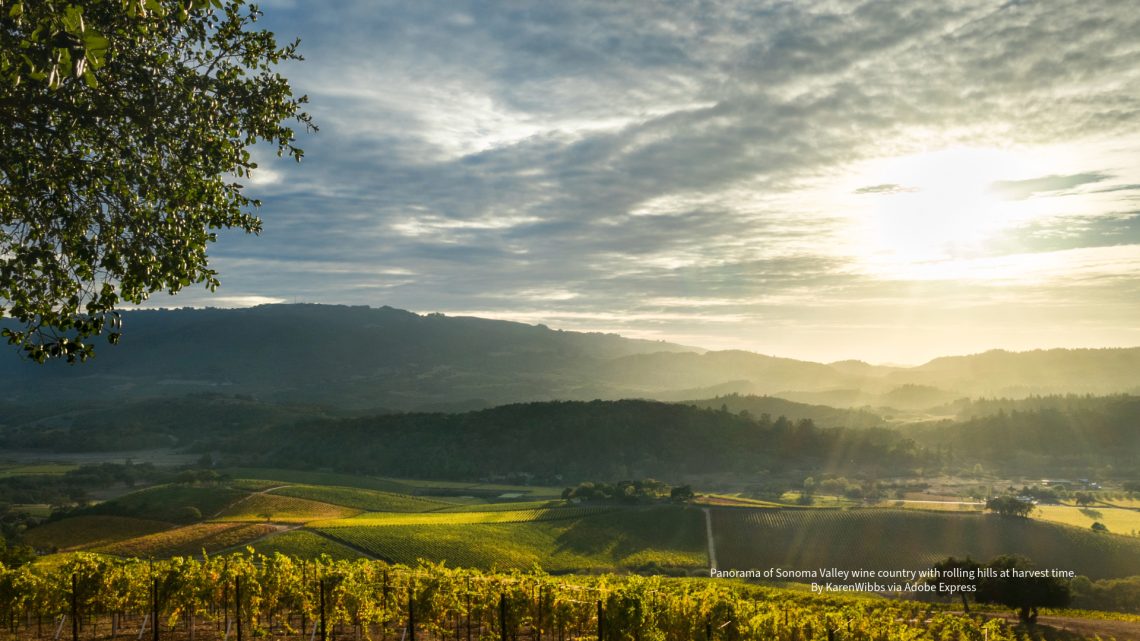
Sonoma Valley AVA
The Sonoma Valley AVA takes in the county’s southeast corner with the AVAs of Bennett Valley, Sonoma Mountain, and Moon Mountain nested within it. Some of the oldest Zinfandel vineyards are here, although Cabernet Sauvignon has taken over. Kunde Family Wines is located here, and the town of Sonoma is the heart of the region.
Bennett Valley AVA
Southeast of the city of Santa Rosa, the Bennett Valley AVA benefits from a break in the mountains that cools the valley in the summer. They grow lots of Rhône varieties here.
Learn more at https://bvgg.org/
Sonoma Mountain AVA
Not much of a mountain; these are mostly hills. It might seem strange, but you will find both Cabernet Sauvignon and Pinot Noir both thriving here! The terrain and difference in slopes creates microclimates where both do exceptionally well. This sub-AVA of the Sonoma Valley allows vineyards to be between 400 and 1,200 feet and only planted on the northern and eastern slopes of the mountain. It does overlap slightly with the Bennett Valley AVA. Benzinger and Kenwood Wineries are located here.
Moon Mountain District Sonoma County AVA
Another nested AVA in Sonoma Valley is the Moon Mountain AVA. This region sits between 400 and 2,200 feet above the Sonoma Valley, the top is so high that you can see San Francisco on a clear day. Vineyards are on southwest-facing slopes, getting sun in the afternoon and crosswinds from the ocean and San Pablo Bay.
Established in 2013, this AVA sits just north of the city of Sonoma.
Los Carneros AVA
Los Carneros AVA is a single AVA that spans the southern part of Napa and Sonoma and sits on the northern edge of San Pablo Bay.
This region is cooler than the valleys to its north and is the perfect place to grow grapes for sparkling wines.
While other varieties are grown here, vineyards in this region are overwhelmingly planted to Chardonnay and Pinot Noir.

For more information
For more information on the appellations in Sonoma, visit https://sonomawine.com/appellations/
Or check out these articles on Crushed Grape Chronicles.
- Episode 6 – The Scenic Route Exploring Sonoma County Wine region
- Sosie Wines – French inspiration in Sonoma County
- Celebrating Merlot month with a Selby Merlot from Sonoma County
- Balletto Vineyard, Sonoma, CA
- Corner 103 more than just wine tasting in Sonoma
- A Day in Sonoma County
- Sonoma Valley
- A Day in Sonoma County
Up next, the Inland Valleys!
Join us tomorrow as we head inland to California’s Inland Valleys!

Robin Renken is a wine writer and Certified Specialist of Wine and WSET 3 Certified. She and her husband Michael travel to wine regions interviewing vineyard owners and winemakers and learning the stories behind the glass.
When not traveling they indulge in cooking and pairing wines with food at home in Las Vegas.

Check out our book series, “Tempting Spoonfuls” available through Amazon!
Inspired by the flavors and aromas in wines, these books create “tempting spoonfuls” of flavors to pair with wines.
“Tempting Spoonfuls – Pairing single bites with glorious wines” – Our first book paired wines from boutique wineries on the west coast, in California, Oregon, and Washington, with delicious spoonfuls.
This book is 60 pages, 18 recipes, lots of beautiful photos, and insights into some fantastic small wineries!
“Tempting Spoonfuls – small bites paired with wines from around the Globe” – This book takes us around the globe to explore 12 wine regions, a wine from the region, and then gives you a recipe for a pairing!
A slightly larger book at 104 pages, this time you learn about pairing with a type of wine from a region. Rather than a specific bottle, you can look for a style of wine from a region and feel confident that it will go well with the recipe pairing we provide. We give you 12 recipes, each to pair with a wine.
The goal is to make your mouth water and encourage you to create your own “Tempting Spoonfuls.”


Leave a reply