

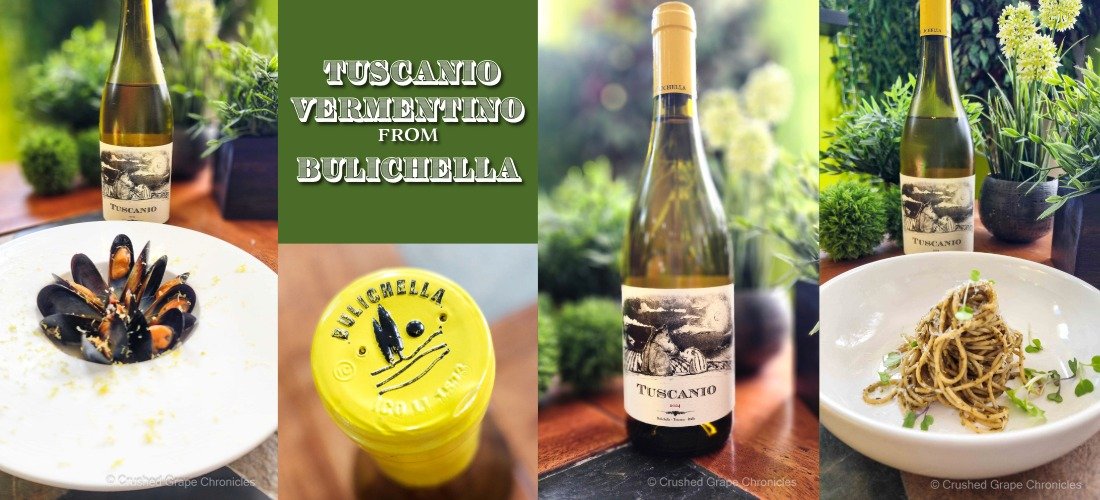
It’s easy as a wine writer to overthink pairings. As I delved into the wines of Bulichella, I looked for pairings that would complement the Japanese/Italian heritage of the family. But sometimes, you just need to stay with the tried and true.
Tuscanio
Tuscanio from Bulichella is 100% Vermentino, a variety well-known in the Mediterranean coastal regions. It flourishes in Corsica and Sardinia, and in southern France, it is known as Rolle. It is also grown here in coastal Tuscany.
This wine is classified as IGT Costa Toscana.
It is a variety that thrives in salt air and with a view of the sea. Here at Bulichella, near Suvereto, the vineyards often have a view of the Tyrrhenian Sea and the Isle of Elba.
These vines are in the “old vineyards”. Last year was a tough Vermentino harvest. They had small quantities, with a wet start to summer that transitioned into a dry end, accompanied by heat spikes.
They are low intervention here, so sometimes Mother Nature simply has her way. They were forced to do manual selection in the vineyard and sorting pad. Some of the berries became sunburned with the heat spikes. This can cause Vermentino to turn brown and develop a purplish hue. Many of the bunches had to have 1/3 of the berries removed due to sunburn.
The wine is fermented and aged in stainless steel for 5 months on the fine lees with periodic batonnage. This shows in the wine, with added viscosity and a warmer mouthfeel.
Clear in color, but with a slight haziness, almost imperceptible, that lends it a visual softness, in your mouth, the texture of the wine reflects this.

Michael and I tasted with the Coravin on the first day to get a feel for the wine. We had just finished shooting the bottle for the photos you see. The wine had warmed a bit. Michael got notes of warm apple, I found saline, and crushed stones. The wine seemed slightly bitter, with notes of green fruit to me. There was also an herbaceous note.
We determined that this wine must be served very chilled to maintain its crispness.
When we opened it the following day, in a more chilled state, we found it offered more in the way of fresh green apple and brighter citrus notes. It still maintained its softness from the fine lees, with a roundness in my mouth.
This wine has some aging potential and is likely to evolve in the bottle over the next two years. The style is very representative of Suvereto Vermentino.
Due to the low quantity of the harvest and local demand, this wine is sold out. We were lucky that their US distributor had a few bottles to send out, so we could taste it. You should watch for the next vintage!
Production: 8,400 bottles ABV: 13% Pricepoint: ~$30
The name Bulichella (sidenote)
Bulichella originates from the word “bulichari,” which refers to the sound of hot spring bubbles. They believe the name originates from the nearby hot springs. You can find a famous one in Sassetta. They also liken the sound of hot springs to the sound of the fermenting wine, which bubbles and blurps.
You will recall that I mentioned a bitter note with this wine the first time we tasted it, along with notes of crushed rock and saline. Perhaps that is channeling the local hot springs.

Pairings
for the Tuscanio
I had planned to do a miso butter pasta with mushrooms. We tasted the miso butter with the wine, and it was just not right. So we went back to some traditional pairings, mussels in a garlic herb butter, and pasta with pesto. Sometimes you just have to go with tried and true.
The mussels elevated the mineral and saline notes in the wine. The pasta (we used wheat pasta) with a hint of lemon zest and fresh Parmigiano Reggiano on top paired perfectly with the wine, heightening the brightness of the lemon zest and the umami notes of the Parmesan. The green notes in the pesto pulled on the herbaceous notes in the wine.
Michael thought this would go well with shrimp and cooked up some breaded shrimp to give it a try. He was not wrong! Shrimp in the pesto pasta would be delicious with this.


The label & the name
This wine was named Tuscanio by his Grandmother. She was in love with Vermentino and thought this was very representative of the region.
The label was sketched by Nico Miyakawa and his cousin. It is of two wild boars (native and well-known in the region), representing the older generation teaching the younger generation. It also marks the passage of the wild boar in the vineyard. They work with the land here, and many animals roam the property. The boars are especially fond of tasting the grapes. Wild boars are known in local folklore as well and are enjoyed on the table. They foster a healthy respect for the natural world, creating space on their property for wildlife and encouraging biodiversity.
The estate is 42 hectares, with just 14-15 hectares planted to vines. Nico says this is the perfect size to be able to personally walk the vineyards in one morning to see how everything is going.
Here is where the Japanese tradition of focusing on details comes in. They look to each plant to ensure it is properly cared for.
*To learn more about Bulichella read our article on their Sol Sera Rosé . Nico, an illustrator and artist in his own right, does marketing for the family winery, and met with us via a Zoom with Studio Cru to tell us about the wines and the farm.


On to the Bulichella Reds!
We will continue to their red wines next. Keep in mind that we are in the Maremma, so the land of Super Tuscans. Get ready for Cabernets and Merlots with some Sangiovese tossed in!
Learn more about their wines at their site https://www.bulichella.it/en/
More on Coastal Tuscan Wines
For more on Bulichella and other Tuscan Coastal wines, check out these articles:

Robin Renken is a wine writer and Certified Specialist of Wine and WSET 3 Certified. She and her husband Michael travel to wine regions interviewing vineyard owners and winemakers and learning the stories behind the glass.
When not traveling they indulge in cooking and pairing wines with food at home in Las Vegas.

Check out our book series, “Tempting Spoonfuls” available through Amazon!
Inspired by the flavors and aromas in wines, these books create “tempting spoonfuls” of flavors to pair with wines.
“Tempting Spoonfuls – Pairing single bites with glorious wines” – Our first book paired wines from boutique wineries on the west coast, in California, Oregon, and Washington, with delicious spoonfuls.
This book is 60 pages, 18 recipes, lots of beautiful photos, and insights into some fantastic small wineries!
“Tempting Spoonfuls – small bites paired with wines from around the Globe” – This book takes us around the globe to explore 12 wine regions, a wine from the region, and then gives you a recipe for a pairing!
A slightly larger book at 104 pages, this time you learn about pairing with a type of wine from a region. Rather than a specific bottle, you can look for a style of wine from a region and feel confident that it will go well with the recipe pairing we provide. We give you 12 recipes, each to pair with a wine.
The goal is to make your mouth water and encourage you to create your own “Tempting Spoonfuls.”


Leave a reply