

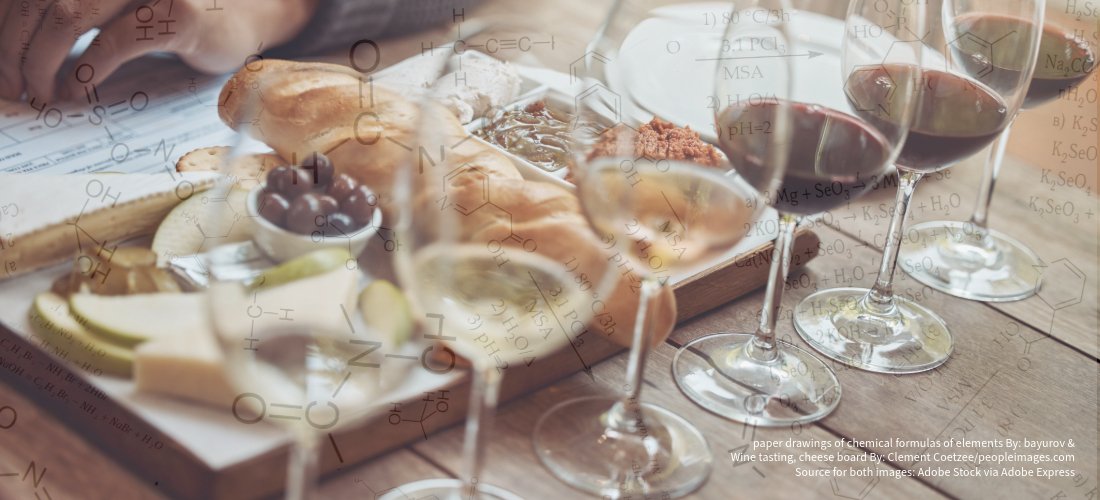
Pairing Food and Wine is something I love. Wine on its own is terrific, don’t get me wrong, but there is something extraordinary about finding a pairing where the food and wine seem to elevate each other.
People talk about “perfect pairings,” and that seems a bit absolute and trite to me. Everyone’s palate differs, so people interpret wine and food pairings differently.
So why is that? And why are there some pairings that seem tried and true to be exceptional?
For this month’s Combined Wine Writers Topic, Wendy of A Day on the Life of the Farm encouraged us to learn and share something new. I thought I would dive deeper into wine and food pairings, looking at some of the logic and some of the Science behind them.
You will find links to my colleagues’ work at the bottom. I expect this to be an exciting and eclectic group of articles!
Logic vs Science with wine and food pairings
When you learn about wine and food, you will find some basic guidelines or platitudes that you will find logical once you test them.
- Red wine with red meat
- White wine with seafood
- The wine should always be sweeter than the food
- What grows together goes together
Let’s dive into the logic and Science behind these.


Red wine with Red Meat
There is some science here! This also applies to red wine and cheese.
Tannins are astringent compounds, so they make your mouth feel dry. Think of sucking on a tea bag. They are also bitter. In wine, they come from the grapes’ seeds, skins, and stems.
Lipids are found in fats, such as fatty cheeses or meats. They attract tannins, pulling them away from the taste receptors in your mouth that register bitterness. Thus, they soften the tannins and the bitter taste.
So that big tannic Cabernet Sauvignon is an excellent pairing with a big, juicy, fatty steak! The lipids in the fat on the steak will bond with the tannins, so the wine is softer in your mouth, and the bitter notes disappear.

White wine with Seafood (or rather no red wine with seafood)
Ferrous ions or FE2+ naturally occur in wine, but the levels are typically low in white wines.
Red wines end up with more FE2+ than white because they usually come into contact with more iron metal objects during the winemaking process.
Mix FE2+ with fish, and you will get flavors of metal, fish (extra fishy), and bitter notes that are unpleasant.
So, white wines and red wines that are made in Stainless Steel, can often pair with fish without creating these metal or fishy notes. It all depends on the FE2+ concentration in the wine.
The wine should always be sweeter than the food
Hmm…here there is less Science (at least not much that I could find). A rule of thumb for sweet wines is to pair them with spicy foods as they balance the heat. But this is a cultural thing. In China and Hong Kong, sommeliers often pair high-alcohol red wines with spicy food. This elevates the heat on your palate, which is something that people in this region enjoy.
Sweet foods often make the wine you sip with them seem drier. This can sometimes throw a dessert pairing out of balance.
But a sweet wine like this Moscato di Scanzo with a sweet dessert, or…the classic port wine with Stilton, where the wine is sweeter than the food are brilliant.
Of course, my palate enjoys chocolate and red wine. This is not for everyone, but with a fruit forward red wine, with no residual sugar and a dark chocolate dessert, I am in heaven.
So, as you can see, this is not a hard and fast rule.

What grows together grows together
Much of this is cultural. Before we were able to send fresh foods across the globe, people could only eat locally. If you were by the sea, you ate fish; inland, you ate more meat. When it came to wine and food, the plants, both vegetables and wine grapes, grew in the same soil and climate, so they were likely to have commonalities that made them work well together.
People got used to eating and drinking these foods and wines together, so their palates evolved to enjoy them.
You will find great examples of these types of pairings in European wine regions:
- Sancerre & Chevre
- Barolo & Truffles
- Chianti & Bistecca Alla Fiorentina


The Truth Behind the Science of Food and Wine Pairing
I love to think that Science has the answer for almost everything. And perhaps it does, but much of that research has simply not yet been done. Quite honestly, I’m okay with that. I would prefer that the really smart scientists concentrate their efforts and brain cells on solving the critical problems in our universe rather than spending their time seeing why food and wine go together.
Besides, I enjoy doing this type of experiment myself and, of course, sharing my results with you!
Fascinating articles by my colleagues
From Cam of Culinary Cam From Xers to Zoomers: Exploring the Decline in Wine Consumption
From Gwendolyn Lawrence Alley, the Wine Predator Celebrating the New Year the Armenian Way: Ghapama and Lamb Kebabs Paired with Areni Wine from Yacoubian-Hobbs
From Linda at My Full Wine Glass: What’s all the hubbub about non-alcoholic wine?
From Jeff at Food Wine Click Hot Topics: A Zero Alcohol Primer
From Andrea at The Quirky Cork Albania: A New Wine Frontier
From Terri at Our Good Life: The Unveiling of Red Wine’s Hidden Health Benefits and the Surgeon General’s No-Alcohol Stance
From Jennifer at Vino Travels: The Alcohol-Removed Wines of Starla
And From Wendy Klik at A Day in the Life on the Farm, who is leading our exploration this month, Exploring a Dealcoholized Wine
Resources and References
- https://axial.acs.org/agriculture-and-food-chemistry/chemistry-of-food-and-wine-pairings
- https://www.technologynetworks.com/applied-sciences/videos/theres-finally-peer-reviewed-chemistry-in-wine-and-food-pairings-365135
- https://winefolk.co.uk/does-red-wine-contain-iron/
- https://pubs.acs.org/doi/abs/10.1021/jf901656k
- https://www.nature.com/articles/srep00196
- https://www.foodpairing.com/the-science-behind-great-ingredient-pairings/

Robin Renken is a wine writer and Certified Specialist of Wine and WSET 3 Certified. She and her husband Michael travel to wine regions interviewing vineyard owners and winemakers and learning the stories behind the glass.
When not traveling they indulge in cooking and pairing wines with food at home in Las Vegas.

Check out our book series, “Tempting Spoonfuls” available through Amazon!
Inspired by the flavors and aromas in wines, these books create “tempting spoonfuls” of flavors to pair with wines.
“Tempting Spoonfuls – Pairing single bites with glorious wines” – Our first book paired wines from boutique wineries on the west coast, in California, Oregon, and Washington, with delicious spoonfuls.
This book is 60 pages, 18 recipes, lots of beautiful photos, and insights into some fantastic small wineries!
“Tempting Spoonfuls – small bites paired with wines from around the Globe” – This book takes us around the globe to explore 12 wine regions, a wine from the region, and then gives you a recipe for a pairing!
A slightly larger book at 104 pages, this time you learn about pairing with a type of wine from a region. Rather than a specific bottle, you can look for a style of wine from a region and feel confident that it will go well with the recipe pairing we provide. We give you 12 recipes, each to pair with a wine.
The goal is to make your mouth water and encourage you to create your own “Tempting Spoonfuls.”


10 comments
Leave your reply.